
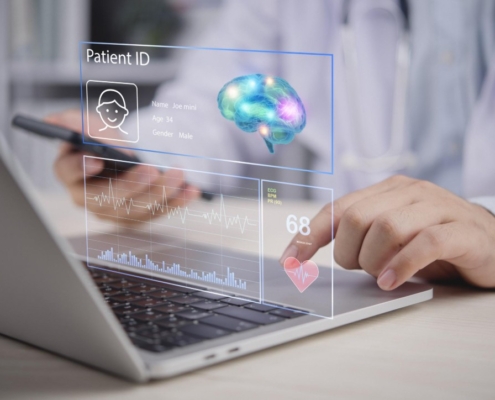
AI EEG Drug-Response Prediction System: Offers a New Path Toward Personalized Depression Treatment
Major depressive disorder (MDD) remains one of the world’s most disabling conditions, yet finding an effective antidepressant treatment often still relies on a prolong trial-and-error process. A research team lead by Professor Syu-Jyun Peng has developed an EEG-based, machine-learning drug-response prediction system designed to help clinicians identify whether a patient is likely to respond to medication within the first weeks of treatment.
The project, “AI EEG Drug-Response Prediction System: Longitudinal Tracking and Personalized Recommendations for Depression Treatment,” received the 2025 IIP International Inventor Prize – International Innovation and Invention Elite Award, highlighting its potential contribution to precision psychiatry and personalized mental healthcare.
Turning Early EEG Signals into Actionable Predictions
Although antidepressants are widely used, patients often need to try multiple medications before finding an effective treatment. This delay can prolong symptoms, increase relapse risk, and place additional burden on patients, families, and healthcare systems.
Associate Professor Peng’s team developed the system based on a key insight: brain network activity may begin to change soon after medication starts, before clinical improvement becomes clearly visible. By capturing these early neurophysiological changes through electroencephalography, or EEG, the system aims to provide objective biomarkers that can support earlier and more individualized treatment decisions.
The study collected EEG recordings from 77 patients with major depressive disorder at baseline (Week 0) and after one week of medication (Week 1). These data were then used to predict treatment response at Weeks 4, 6, and 8 through machine-learning models combining EEG-derived features and clinical variables.
A Practical Pipeline for Real-World Clinics
The system was designed with real-world clinical application in mind. EEG is non-invasive, relatively affordable, and suitable for repeated monitoring, making it a promising tool for psychiatric care.
In the research pipeline, EEG signals are preprocessed and divided into canonical frequency bands (delta, theta, alpha, and beta) and converted into interpretable features.
The team focused on two complementary domains:
- Power-based metrics (absolute and relative power), capturing spectral characteristics of brain activity.
- Functional connectivity and phase synchronization metrics—including PLV, PLI, and wPLI, which measure how different brain regions coordinate with one another.
The team also computed a change index, comparing Week 1 and Week 0 EEG patterns, to identify early brain changes that may predict later treatment outcomes.
Promising Prediction Performance
The system achieved strong predictive results, with accuracy reaching 83.1% for Week 4, 73.3% for Week 6, and 80.0% for Week 8 treatment response.
Functional connectivity and phase synchronization features consistently emerged as major contributors to predictive performance. These findings support the idea that early changes in brain network dynamics may serve as meaningful biomarkers for antidepressant response.
From Research Prototype to Precision Psychiatry
The “heart” of this project was never just algorithm tuning—it was learning to build something that clinicians can confidently trust. Early on, EEG data can be complex and affected by artifacts, individual differences, and recording conditions. To address these challenges, the team refined preprocessing methods, strengthened artifact handling, and selected interpretable features with clinical relevance.
Following recognition at the 2025 IIP International Inventor Prize, the project will move toward larger-scale validation and clinical translation. Future development will focus on multi-site studies, clinician-friendly decision-support interface, multimodal data integration, and broader healthcare applications.
By helping clinicians identify likely treatment responders earlier, the system has the potential to reduce ineffective medication trials, shorten time to remission, and support more personalized depression care.
Advancing Personalized Mental Healthcare
This award-winning AI EEG drug-response prediction system represents an important step toward precision psychiatry. By combining EEG, machine learning, and longitudinal treatment tracking, Associate Professor Peng’s team aims to transform early brain responses into actionable clinical insights, which is helping patients move more quickly toward effective care.





 Total Users : 496241